explore
Find ragas and compositions
Search by raga, thaat, time of day or tala. Choose a library and a level (Beginner, Medium, Pro) and see only what fits your student.
Sangeet4All Raga App
An interactive library of ragas, compositions and exercises from trusted sources. Write notation the way you would in your riyaz copy, hear every line with tanpura, and give each student a workbook they can open on their phone.
Our aim: the largest interactive library of Indian music, built one carefully sourced collection at a time.
What it does
explore
Search by raga, thaat, time of day or tala. Choose a library and a level (Beginner, Medium, Pro) and see only what fits your student.
listen
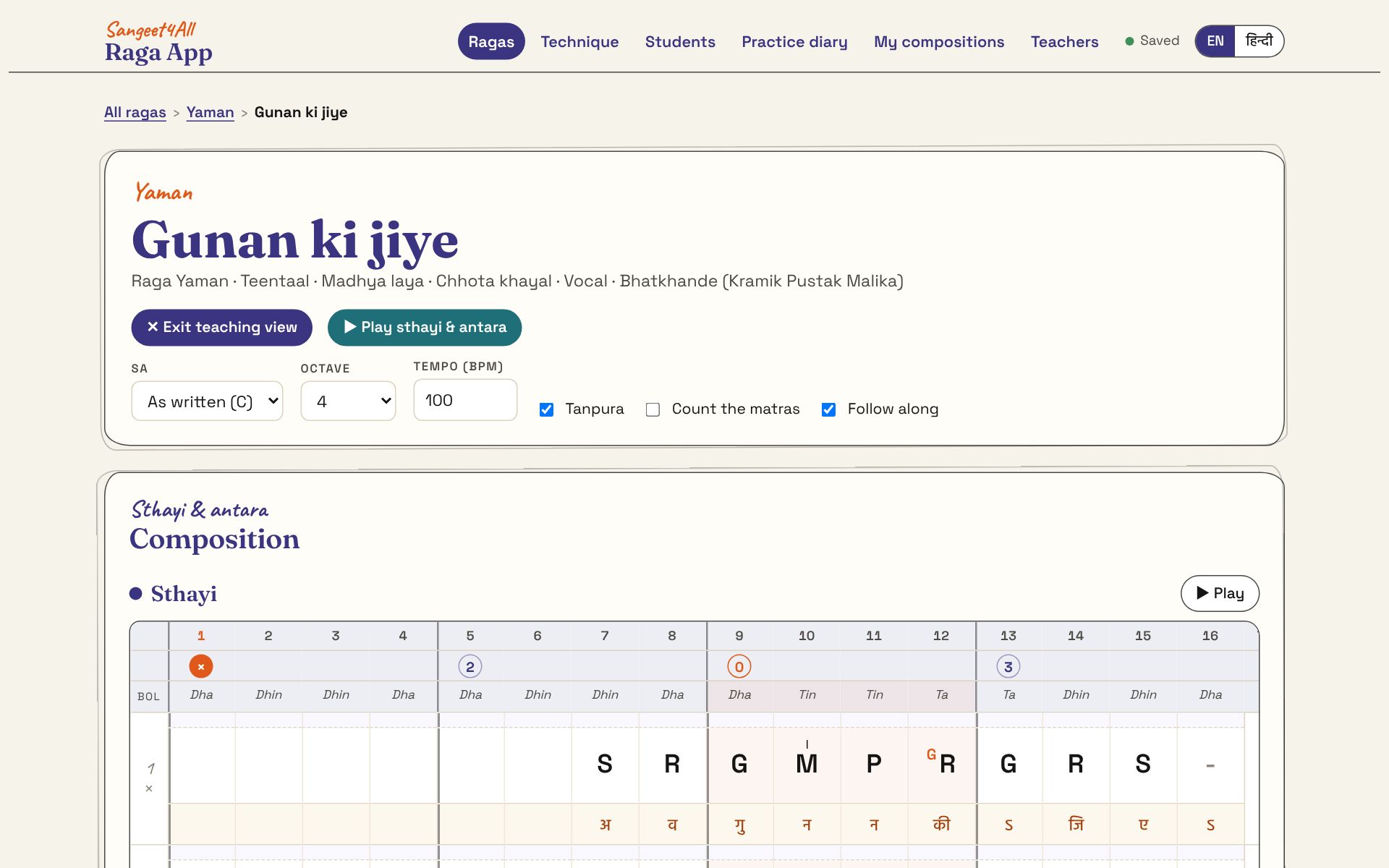
Play a composition with tanpura and a tabla theka, or with a metronome that marks sam, tali and khali. Slow it down for practice, and move Sa to suit any voice or instrument. Repeats are played as written.
write
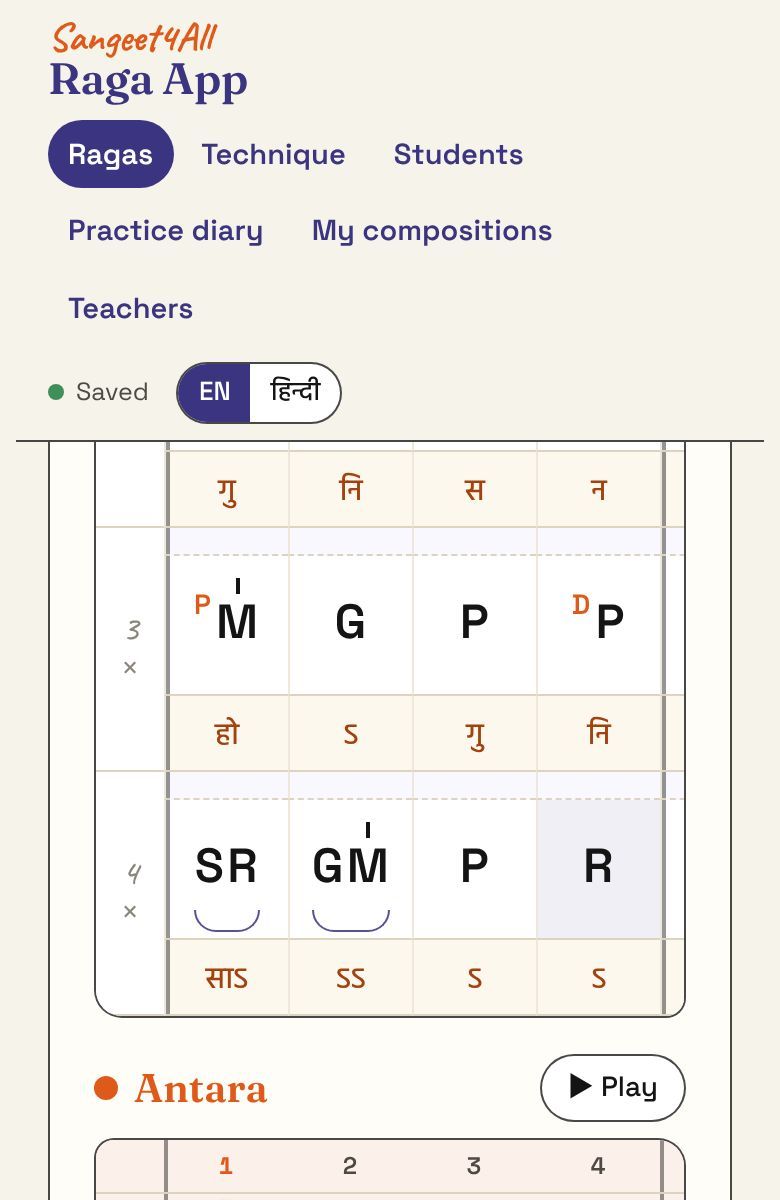
Click a matra and type sargam. Kan, meend, khatka and holds are drawn for you, in Roman or Devanagari, in any tala, including talas you create yourself.
arrange
Add vocal, sitar, bowed strings, bansuri, harmonium chords or tabla bols to one score. Export staff notation for MuseScore, Finale, Dorico and Sibelius.
riyaz
Lines repeat as they are sung in class, with a count-in before you start. Loop a passage and let the speed rise a few BPM each round. Write any line in dugun, tigun, chaugun, aad or any jati with one click.
layakari
The calculator finds where a tihai or chakradar must start to land on sam, or on any matra, and tells you when it is farmaishi. Tabla has its own sections for kaida, paltas, relas and tihais, a khali version in one click, and every theka.
shruti
Set the shruti of each swara in a raga, from the very low komal Re of Todi to natural intonation, and hear it in every composition of that raga. Carnatic swara names are shown alongside.
teach
Choose ragas, compositions and exercises for each student or a whole class. Set homework and projects, give marks and feedback.
practise
Students log their daily riyaz in their workbook and send it to you with one tap. You reply, and they see your feedback in their updated workbook.
The libraries
Each collection is transcribed from an authoritative book or a living tradition, and credited. New libraries open as they are checked.
Teachers also keep their own compositions in the app, privately. Have a collection that belongs here: a guru’s notebooks, a school songbook, a regional repertoire? Write to us.
Who it is for
Prepare lessons from the library or your own notation, play them in class, and send each student exactly what they need to practise.
One workbook for a whole class, with homework, projects and marks for every student. It fits the Sangeet4All school programme.
From about Class 6 onwards. Open your workbook on any phone, hear every line, and keep your practice diary. No account needed.
Write scores for an ensemble, hand out parts, export staff notation, and prepare score packages of your own work to share or sell.
Compare compositions of one raga across books and gharanas, and hear what the notation in the old texts sounds like.
A short guide
You get an email with a link to choose your password. After that you go straight into the app. Next time, open sangeet4all.com/raga-app and sign in with your email.
On Ragas, search by name, or filter by thaat, time of day or tala. Use Library and Level at the top to see only one collection or one level.
Press Play. Switch on tanpura, tabla or the metronome, change the speed, or move Sa. Teaching view gives a clean page for the classroom screen.
Under My compositions, start a new one, choose the tala, click a matra and type: S R G m P D N, komal r g d n, tivra m, mandra .N, taar S., kan {M}R, meend (M G R), hold S - -.
Under Students, make a workbook for one student or a class and add ragas, compositions and exercises. Download it and send it by WhatsApp or email: it opens on any phone, even offline, and the practice diary comes back to you the same way.
Questions
No. The Raga App opens in the browser on a phone, tablet or computer. On a phone you can add it to your home screen from the browser menu, and it opens like any other app.
No. Students get their workbook as a private link, or as a single file that works without internet. It opens on any phone or computer and plays every line, and they can slow it down for practice. Only teachers sign in.
The Raga App opens first to a small circle of founding members: teachers, schools and musicians who use it from the start and help shape it with their experience. Sign up below and we will write to you when your place is ready.
For now the Raga App is open only to founding members. Plans for teachers, students and schools will follow, and public-domain material will stay free.
The sargam notation most of India learns from Bhatkhande: dots for mandra and taar saptak, a line under komal notes and a mark over tivra Ma, with vibhags and tali and khali signs. You can type in Roman letters or Devanagari, and export staff notation (MusicXML) whenever you need it.
Today the app plays the melody with its own sound, together with tanpura, tabla and chords, and shows the words under the notes. Next come real recordings: tanpura, tabla and instruments recorded by Sangeet4All musicians, sargam sung by a Sangeet4All singer, and songs sung by artists, played in step with the notation.
Only you. Every teacher shares the library, but your own compositions, students, classes and diaries are yours alone. If you change a library item, the change is yours too; the library stays the same for everyone else.
Each library names its source: the Sitar library comes from the Maihar gharana, with the notebooks of NR Ramarao; the Bhatkhande library from the Kramik Pustak Malika. Every new library is checked before it opens.
English and Hindi now, switchable at the top of the app. The language you choose is carried into your students’ workbooks. Regional languages will follow.
The Carnatic libraries are in preparation, beginning with the first lessons of Purandara Dasa, the Trinity and varnams.
Yes. Classes have one workbook for all students, homework and projects with marks, and a practice diary for each student. The app works alongside the Sangeet4All school programme. Sign up below as a founding member and tell us about your school.
Founding membership
The Raga App opens first to a small circle of teachers, schools and musicians who use it from the start and help shape it.
Tell us a little about yourself, and we will write to you with your sign-in link when your place is ready.
Questions? Write to admin@sangeet4all.com
About
The Raga App was created by Vidushi Saskia Rao-de Haas, creator of the Indian cello and of the patented Swartarang, founder of Sangeet4All, and Knight of the Order of Orange-Nassau.
Sangeet4All is a music education programme for schools in India. Its aim is to bring every child into the living world of Indian music, and the Raga App carries that aim into every music room and onto every student’s phone.